Last Updated:
Dunkin Donuts Bagel: Every Flavor, Price and Calorie Count 2026 Guide
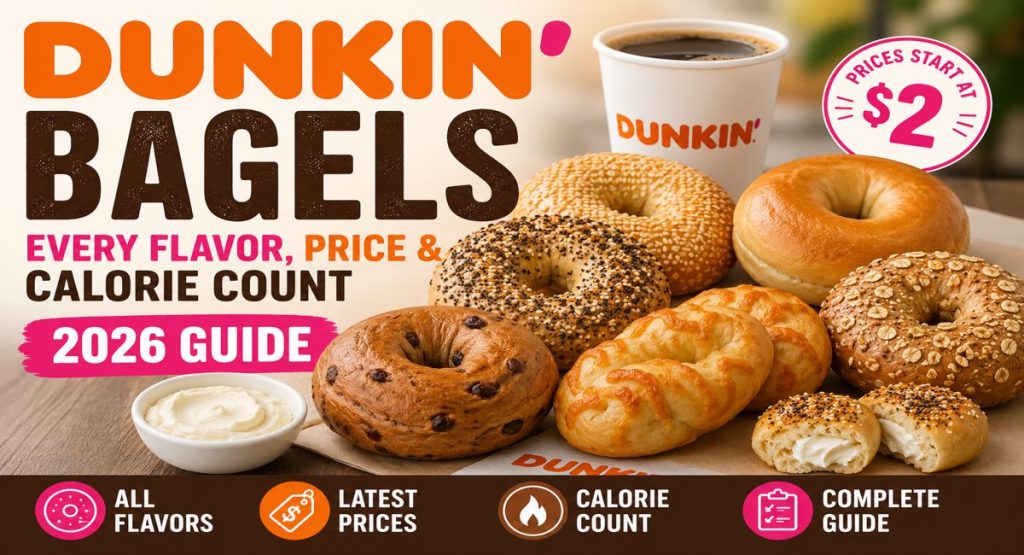
Dunkin is best known for its donuts and coffee, but bagels have been a permanent menu item for nearly three decades. Introduced in 1996, Dunkin bagels remain a popular breakfast choice for customers looking for a more filling option. This guide covers everything you need to know about Dunkin Donuts bagels in 2026, including every available flavor, current prices, and detailed calorie information.
You’ll also learn the differences between classic bagels, Stuffed Bagel Minis, and Bagel Twists, along with how Dunkin prepares its bagels and why they may sometimes look different from promotional images. Since most Dunkin locations are independently franchised, prices and availability can vary by location.
Quick Answer: A single Dunkin bagel typically runs $2–$3, with cream cheese pushing it closer to $3.50–$4.50. Calories range from about 300 for a plain bagel up to 380+ for multigrain or as part of a breakfast sandwich. Jump to the full nutrition table below for exact numbers by flavor.
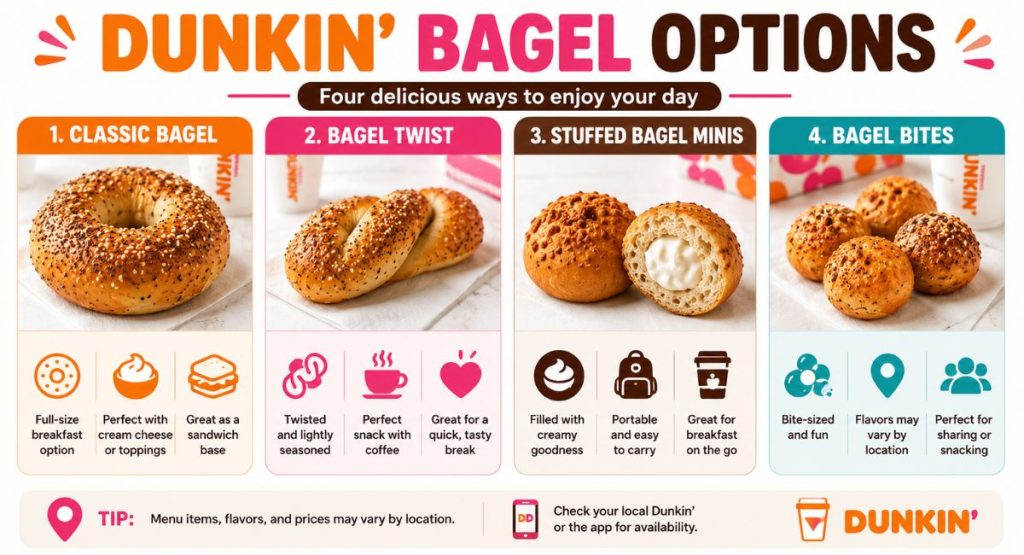
What Bagel Products Does Dunkin Actually Sell?
Dunkin bagels as a single item, but the menu actually includes four different bagel categories. This often confuses customers because each option varies in size, flavors, fillings, and calories. Here’s a quick breakdown of each one.
Classic Bagels
These are the standalone, full-size bagels you can order plain or turn into a sandwich. Current dunkin bagel flavors typically include:
If you’re wondering what kind of bagels does Dunkin’ have at your specific location, the honest answer is: it depends. Not every store carries the full lineup onion and wheat bagels in particular seem to rotate in and out more than the others.
Bagel Twist (White Cheddar)
The bagel twist dunkin locations sell is a different shape and format entirely a twisted braid of dough rather than the standard ring, folded through with cheddar cheese. The dunkin cheddar bagel twist is savory on its own, no cream cheese needed, and functions more like a snack item than a breakfast base you’d build a sandwich on.
Stuffed Bagel Minis
Dunkin stuffed bagel minis are small, round bagel bites that come pre-filled with cream cheese and are served warm. They’re sold in a 2-piece serving (Plain or Everything) and are meant to be eaten as-is you’re not adding your own spread. Think of them as the grab-and-go answer to a full bagel-and-cream-cheese order.
Bagel Bites
This is where the confusion really sets in. Bagel bites and stuffed bagel minis get used interchangeably by customers, but at Dunkin’, they’re not automatically the same product bite-sized bagel pieces can appear on the menu without the stuffed cream cheese filling, depending on how the item is currently formatted at your store. If you’re specifically after the cream-cheese-filled version, ask for Stuffed Bagel Minis by name to avoid getting a plain bagel bite instead.
Dunkin Bagel Prices: What You’ll Actually Pay
If you’ve searched how much is a bagel at dunkin and gotten three different answers from three different sites, you’re not imagining things. Bagels dunkin donuts cost varies more than you’d expect for a fast-food menu item, and there’s a real reason for that (more below).
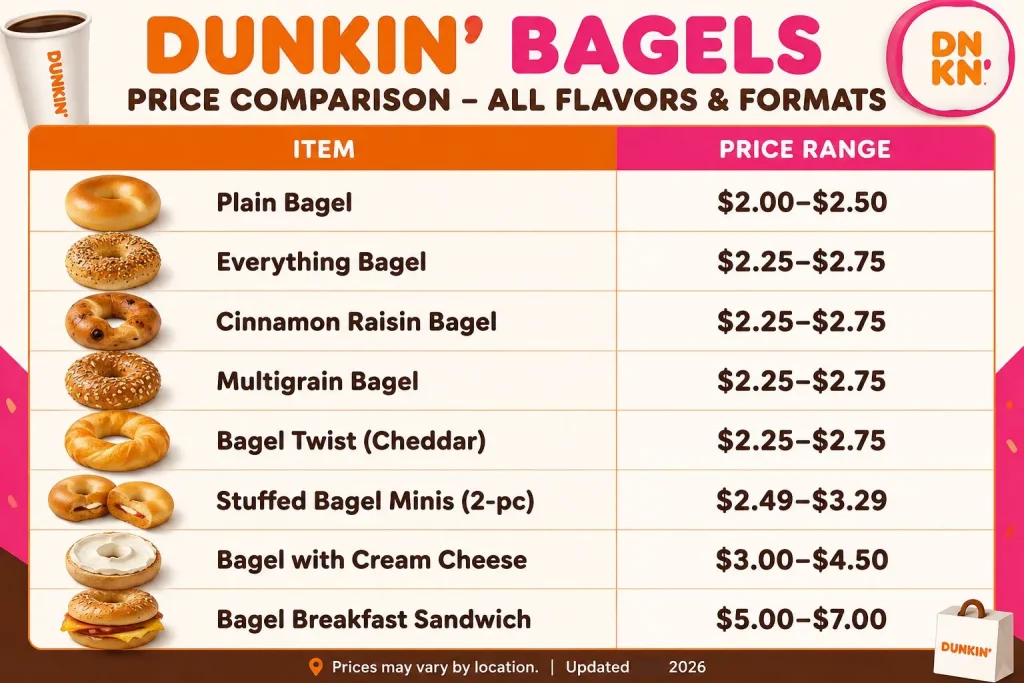
Bagel Alone vs. With Cream Cheese vs. As a Sandwich
As a rough guide, here’s what to expect:
- Bagel alone: roughly $2.00–$3.00
- Bagel with cream cheese: roughly $3.00–$4.50
- Bagel as a breakfast sandwich (bacon/sausage, egg, cheese): roughly $5.00–$7.00
The jump between “bagel alone” and “bagel with cream cheese” is where a lot of people get caught off guard — cream cheese, toasting requests, and any sandwich add-ons are priced on top of the base bagel, not bundled in. If you’re ordering from bagel from dunkin donuts locations regularly, it’s worth checking your receipt the first time to see exactly how your store breaks out those charges.
Why Prices Vary by Location
Here’s the part most menu-price sites don’t explain: Dunkin’ is almost entirely a franchise system. Individual store owners set their own prices, within some general guidance from the company which means the same plain bagel can cost noticeably different amounts in two towns twenty minutes apart. It’s not a pricing error or a scam; it’s just how the business is structured.
Franchise Pricing Explained: Because Dunkin’ locations are independently owned and operated, menu prices aren’t set nationally. Regional costs, competition, and individual franchise decisions all factor in — so treat any price listed online (including this one) as a solid estimate, not a guarantee.
The most reliable way to get an exact number for your order is to check the Dunkin’ app, which pulls live pricing for your specific store.
Dunkin Bagel Calories and Nutrition Facts
This is where diet-tracking searches tend to land, and it’s also where a lot of competing menu sites cut corners — publishing one nutrition table (usually for cinnamon raisin, oddly) and letting readers assume it applies to every flavor. It doesn’t. Sodium, fiber, and calories all shift depending on which bagel you order.
Calories by Flavor
Here’s how the core lineup compares, based on official nutrition data:
Figures sourced from Dunkin’s official nutrition information; always confirm against the current app listing, since formulations and portions do get updated.
Calories With Common Add-Ons
The number that trips people up most is dunkin bacon egg and cheese bagel calories — because the base bagel calorie count and the finished sandwich calorie count are two very different things. Adding egg, cheese, and a breakfast meat roughly doubles the calorie total of the bagel alone. If you’re tracking macros, always check the full sandwich listing rather than adding a base bagel number to a rough guess at the extras the difference is bigger than most people expect.
Is a Dunkin’ Bagel a Healthy Choice?
Short answer: it’s carb-heavy, moderate-protein, and not automatically the healthy option just because it’s not a donut. A plain bagel and a glazed donut aren’t as far apart in calories as people assume — the bagel usually wins on protein and loses on sodium, but it’s not the clean swap it’s often treated as.
The multigrain-vs-plain comparison is a good example of a common misconception. People assume multigrain is meaningfully lighter, but the calorie gap between plain and multigrain is often smaller than expected — multigrain frequently runs higher in calories, even though it sounds like the better-for-you pick. If fiber and sustained energy matter more to you than raw calorie count, multigrain still has an edge — just don’t expect a big calorie savings.
Are Dunkin Bagels Fresh or Frozen?
This is the question that generates the most genuine frustration, and it deserves a straight answer instead of marketing language.
Dunkin’ has described its bagels as “fresh” for years. In practice, based on reporting from current and former employees, the overwhelming majority of Dunkin’ bagels today are what’s called FTO freezer-to-oven. That means the bagels arrive at the store pre-shaped and frozen, then go straight into the oven without needing to be thawed first. This is different from how things worked years ago, when many locations either baked dough delivered fresh each morning or received bagels baked off-site and delivered daily.
What FTO Means: Freezer-to-oven (FTO) bagels are shipped to stores frozen and pre-shaped, then baked to order without a separate thawing step. It’s a supply-chain method built for consistency and speed across thousands of locations — not the same as scratch-baked, but not the same as a microwaved, fully-baked-elsewhere product either.
So does Dunkin’ make their own bagels? Not in the traditional, mixed-and-shaped-in-store sense, at most locations today. The oven part happens in-store; the shaping and freezing happens elsewhere. That’s a meaningful difference from made fresh daily, and it’s worth knowing before you’re disappointed by a bagel that doesn’t match a bakery-fresh expectation.
Ingredients and Allergen Information
If you’re managing allergies or just curious what’s actually in the dough, the ingredient list varies by flavor, but the core allergens stay consistent across the lineup.
Common allergens:
- Wheat present in every bagel, since they’re all flour-based
- Soy used in dough conditioning across most flavors
- May contain traces of milk, egg, or tree nuts — due to shared prep equipment, even in flavors that don’t list these as direct ingredients
A cinnamon raisin bagel, for example, typically includes enriched wheat flour, raisins, sugar, wheat gluten, malted barley extract, yeast, cinnamon, and dough conditioners a longer list than a plain bagel, which sticks closer to flour, water, yeast, and salt.
Gluten-free guidance: None of Dunkin’s bagels are gluten-free. If gluten is a concern, this entire category — bagels, twists, minis, and bites is off the table, since they’re all made from wheat flour. There’s no dedicated gluten-free bagel alternative currently offered.
If allergens are a serious concern for you, don’t rely on any third-party summary (including this one) as the final word — cross-check against Dunkin’s official allergen documentation before ordering, since formulations can change without much notice.
Are Dunkin Bagels Actually Good? What Customers Say
Taste is subjective, but the feedback pattern is pretty consistent: people generally like the flavor, and the complaints tend to cluster around texture and consistency rather than the underlying recipe itself.
On the positive side, the everything bagel and cinnamon raisin bagel tend to get the most praise solid seasoning, decent chew, reliable pairing with Dunkin’s coffee lineup. The stuffed bagel minis also land well with people who want something quick without assembling their own bagel-and-spread combo.
On the negative side, the most repeated complaint is texture bagels described as stale, overly dense, or tough enough that chewy undersells it. This tracks with the FTO reality covered above: a frozen-to-oven bagel that isn’t baked long enough, or that’s sat out too long after baking, is going to land tougher than a fresh-baked one. It’s inconsistent by nature of the process, which means your experience really can vary bagel to bagel, not just location to location.
If you get one that seems off, toasting it can help a few extra minutes of heat softens a lot of the “day-old” texture people complain about. It’s a small ask, and most locations are happy to toast it a little longer if you request it at the counter.
The Misshapen Bagel Issue What to Do About It
Every so often, someone posts a Dunkin’ bagel that barely looks like a bagel a giant hole with a thin ring of bread around it, sometimes joked about online as looking almost bracelet-shaped. It’s a real, recurring shape issue, not a one-off fluke, and it comes down to the same FTO process: pre-shaped frozen dough doesn’t always proof or bake evenly, and a bagel that over-expands during baking ends up with an oversized center hole and thin sides.
It’s not dangerous or a sign of bad ingredients — it’s a baking consistency issue. But it does mean you’re not getting the same amount of bagel you’d expect, which matters if you’re paying full price for it.
What to Do If Your Bagel Looks Off:
- If it arrives visibly misshapen, under-filled, or oddly thin, ask the counter staff for a remake — this is a known enough issue that most employees won’t push back
- If you’re ordering ahead through the app, do a quick visual check before you leave the store when possible
- A single misshapen bagel isn’t worth a formal complaint to corporate, but a pattern at the same location might be worth mentioning to a manager
This is one of those small, practical things that rarely gets covered on menu-price sites, but it’s genuinely useful to know before it happens to you.
Cream Cheese and Spread Options
Dunkin’ offers a small but solid range of cream cheese spreads to go with any of the classic bagels:

- Plain Cream Cheese — the default, works with everything
- Veggie Cream Cheese — herb and vegetable blend, leans savory
- Chive Cream Cheese — milder savory option, good with sesame or plain
If you’re looking to lighten things up, a lower-fat or Neufchâtel-style cream cheese swap (where available) trims some fat without much taste difference. That said, Dunkin’s own spread menu is limited to what’s listed above — anything beyond that (like avocado or flavored spreads) isn’t a standard offering at most locations, regardless of what you might see suggested elsewhere.
Pairing suggestions:
How to Order Dunkin Bagels
You can order a Dunkin’ bagel either through the app or in person, and there are small but real advantages to each.
Ordering through the app lets you see your specific store’s current menu, pricing, and stock which, given everything covered above about franchise pricing and flavor availability, is genuinely the most reliable way to know what you’ll actually pay and what’s actually in stock before you show up.
Ordering in-store gives you more flexibility to customize on the spot asking for extra toasting, a specific spread amount, or swapping a sandwich component and lets you visually check the bagel before you commit to it.
A couple of practical habits worth building:
- Compare the app price to the in-store price occasionally; they don’t always match exactly
- If you’re building a sandwich, ask what’s included in the base price versus what’s an upcharge, since that’s rarely spelled out clearly on the menu board
- If you have an allergy concern, ask in person rather than relying solely on app labeling, since ingredient info can lag behind reformulations
Conclusion
Dunkin’s bagel menu is bigger and more varied than it gets credit for — seven classic flavors, a cheddar twist, and cream-cheese-stuffed minis, each with its own price, calorie count, and quirks. The goal here wasn’t just to list what’s on the menu, but to actually explain the parts that usually get glossed over: why your bagel might cost more than your friend’s, why it might come out a little tougher than expected, and what “fresh” really means when the process behind it is freezer-to-oven rather than scratch-baked.
If there’s one thing worth taking away, it’s this: treat any bagel price or flavor list including this one as a solid starting point, not gospel. Franchise pricing and local stock make Dunkin’s bagel menu genuinely variable from store to store.
FAQs
What kind of bagels does Dunkin’ have?
Dunkin currently carries plain, everything, sesame, cinnamon raisin, multigrain, onion, and wheat bagels, plus a cheddar bagel twist and cream-cheese-filled stuffed bagel minis. Not every flavor is available at every location.
Are Dunkin Donuts bagels any good?
Most people rate the flavor positively, especially the everything and cinnamon raisin varieties. The most common complaint is texture — some bagels come out stale or dense due to the freezer-to-oven baking process, which can vary from batch to batch.
Is Dunkin bagel healthy?
It’s a moderate-calorie, carb-heavy option — not automatically healthier than a donut, though it typically offers more protein and less sugar. Multigrain doesn’t save you as many calories as you’d expect compared to plain.
Does Dunkin’ make their own bagels?
Not from scratch at most locations. The bagels are baked in-store, but they arrive pre-shaped and frozen (FTO, or freezer-to-oven) rather than mixed and shaped on-site.
How much does a bagel cost at Dunkin’?
A plain bagel typically runs $2.00–$2.50, with cream cheese pushing the total to around $3.00–$4.50. Exact pricing depends on your location, since Dunkin’ is a franchise system.
What’s the difference between Stuffed Bagel Minis and Bagel Bites?
Stuffed Bagel Minis are a specific 2-piece product pre-filled with cream cheese. Bagel bites is a looser term that can refer to smaller, unfilled bagel pieces depending on how the item is currently offered at your store ask for Stuffed Bagel Minis by name if you want the cream-cheese-filled version.
What’s in the cheddar bagel twist?
It’s a twisted bagel dough baked with white cheddar cheese folded through it — a savory, standalone item that doesn’t need cream cheese or other toppings.
Why do bagel prices differ between locations?
Dunkin’ stores are almost entirely independently owned and operated franchises, so individual owners set their own prices within general company guidance. That’s why the same bagel can cost different amounts at two nearby locations.
What should I do if my bagel arrives misshapen or stale?
Ask for a remake at the counter — it’s a common enough issue tied to the freezer-to-oven baking process that most staff will accommodate the request without hassle.